Around the Crown 10K Race Director Brian Mister on Sustainability, Art, and Inclusive Initiatives
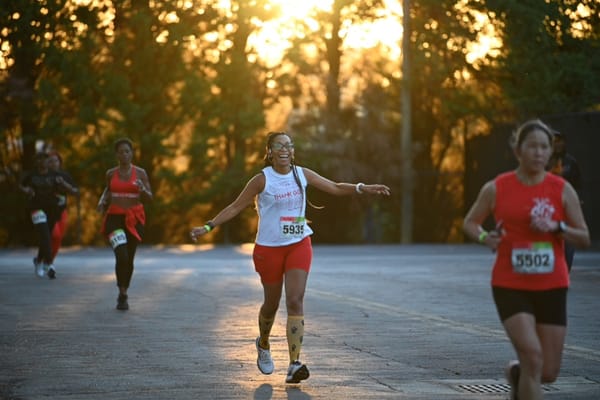
Each Labor Day weekend, Charlotte’s inner beltway shuts down for thousands of runners to run the Around the Crown 10K. Race Director Brian Mister shares the race’s founding story and its community-focused initiatives in the Queen City.

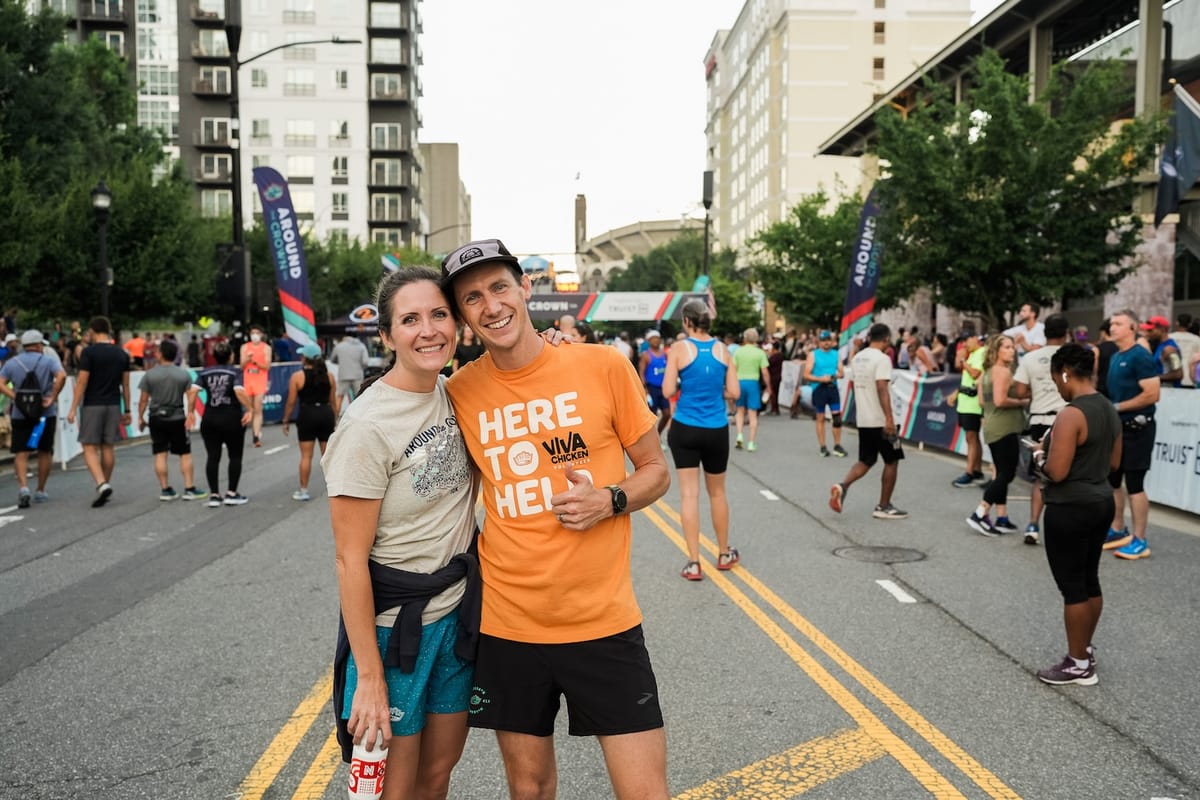
Have you ever been stuck in freeway traffic on your way home and thought to yourself, “I could run home faster than this”?
For Brian Mister and his wife Chelsea, that thought turned into an idea for a race, which took shape as the Around the Crown 10K, first held in 2019 on Labor Day weekend in Charlotte.
“A motto that we have is, ‘We change the speed limit from 50 to 5,’” says Brian, the event’s race director.
In addition to blistering fast race times — there are plenty of those and the awards to match — Brian says running on Charlotte’s inner beltway offers a moment to slow down and enjoy the Queen City from a special vantage point.
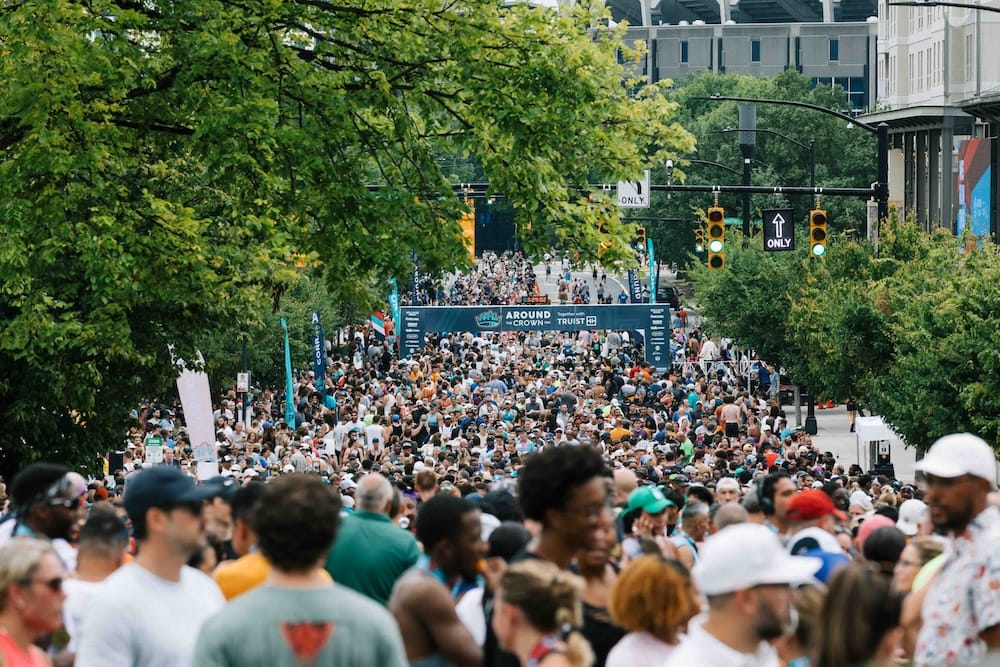
Going into its seventh year, Around the Crown 10K Together with Truist (ATC10K) was recently recognized as the largest single-distance race in the state and one of the top 25 10Ks in the country.
On the decision to create a 10K race instead of a half or full marathon, Brian explains, “I think one piece that any marathon can unfortunately miss is just that word is such a barrier.”
He says he found that the retention rate for 10Ks is high, and when scheduled on a holiday weekend, events seem to thrive in subsequent years.
“I think that I can comfortably and happily say we’re at that point, or pretty darn close to it, that the city recognizes this is something fun you do on Labor Day weekend,” Brian shares.
The one-of-a-kind course in a major city center is likely a leading factor in its popularity. But beyond the race course, Around the Crown’s initiatives in inclusivity and sustainability are strengthening its roots in the community and differentiating it from other road races.
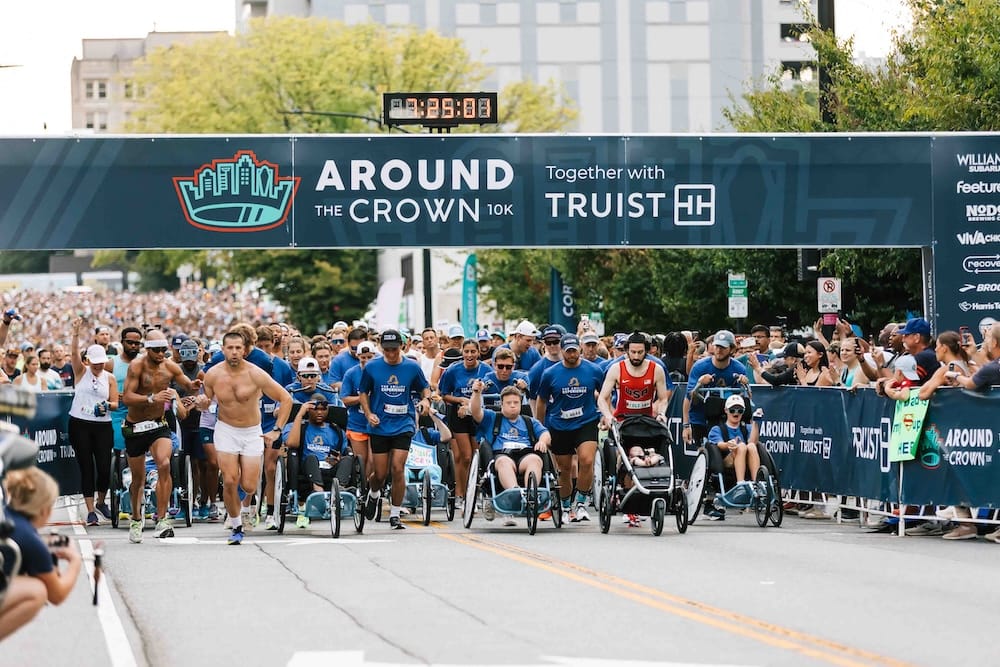
To make sure all runners, no matter their socioeconomic status, have the opportunity to participate on race day, Brian implemented a “pay what you can” program — an initiative he encourages other race directors across the country to adopt.
“Something that we’ve said is we really want to work towards our start line looking like our community. And it’s not something that you can just flip a switch and change overnight,” Brian explains. “This is a really strong initiative that has done a lot of good, and the more marginalized communities and the zip codes that exist in there have some of our strongest growth.”
As for sustainability, Around the Crown’s T-shirt vendor uses recycled materials, aid stations are cup-less, participants can opt out of receiving a race medal, and composting stations are at the finish line for the compostable snacks provided.
Below, Brian shares more on the inspiration behind the race, the Pay What You Can presented by Truist initiative, the artist-designed race swag, and what you should do around Charlotte if you’re visiting for the event.
How did you get involved in the running community?
Brian Mister: Like I’ve heard a few times throughout the industry, it starts with a different sport, and then you slowly get into it. So for me, that was soccer growing up and quickly led all the way to just running — you know, first 5K, first 10K. And each time, after you get done with that distance, you say to yourself, ‘Oh man, I can’t go any further. I can’t go any further.’ And you end up doing that.
I was working at a brewery [NoDa Brewing Company] in college, which was an amazing college job to have. I started running during lunchtime, and then after work some days …. I was like, ‘Oh, it would be fun to have a run club here. I wonder what that would look like.’
It started with three people. The next week, it was 13. The next it was 30. Then we were at 100 within a month or two. We were really the only brewery at the time doing it, and it just became this social gathering where you happen to run.
From the run club, I went and worked out of the U.S. National Whitewater Center …. That got me more into biking and running. And then from there, I went on to the Charlotte Marathon …. I was marketing director there for a few years.
What sparked the idea to run a race on Charlotte’s inner beltway, and has the event lived up to your vision?
Brian Mister: We were driving home on the inner beltway in Charlotte and stuck in traffic, and I decided that I wanted to try to beat my wife home — get out of the car and race her home — which she did not let me do. I stayed in the car. But we kept joking around about, like, gosh, that would be cool to do. And we didn’t fully know what that would look like. I think, at the time, we were just thinking like the typical 5K or half marathon, or something like that.
The name popped into our head before we even had the event — the idea of Around the Crown. We just thought it was such a good play on the city, where Charlotte is known as the Queen City. Everyone looks at the skyline as her crown that she wears, and we run around it within the inner beltway.
That was back in 2017 when that idea was first coming to mind. And then 2019 was the first year of it when everything got lined up when it comes to permits and sponsors.
Seeing those signs [about the freeway closure] for the first time back in 2019, we’re like, ‘Oh, man, this is huge.’ This is like a digital billboard going up, alerting people that some crazy runners have shut down the highway and the first-of-its-kind type of thing.
We’ve had many people tell us [about] the goosebumps feeling when you get out there, because you never get to see your city from that vantage point. It feels like you’re on a helicopter ride around the city. It feels like you shouldn’t be there, which you probably shouldn’t if we weren’t closing down the roads and everything.
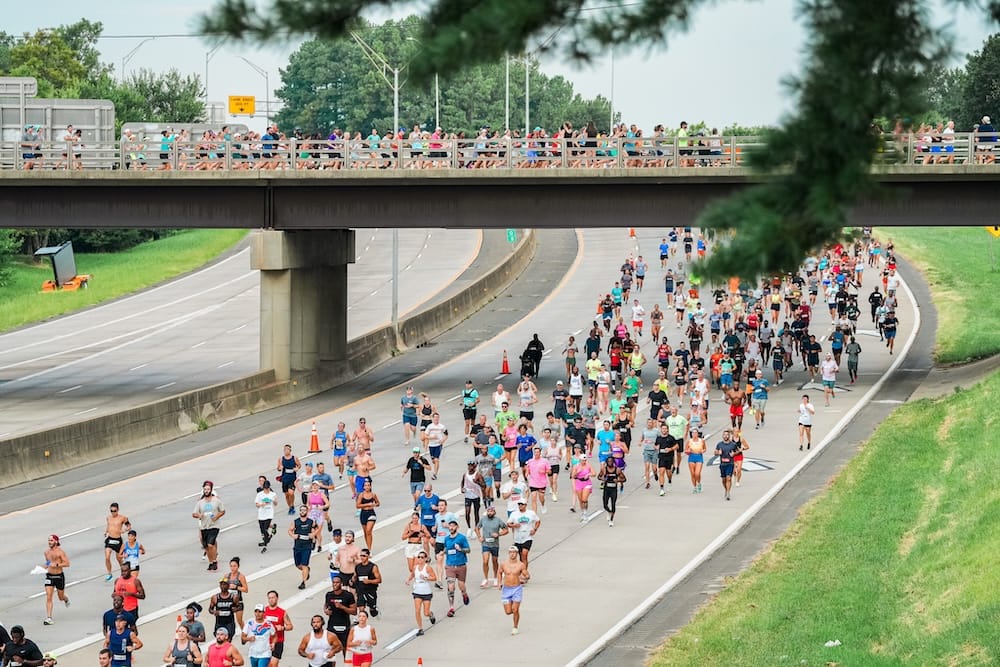
There are quite a few agencies involved, public and private, to assist in safely closing down this section of the inner beltway, or the entirety of the inner beltway, and then also reopening it and getting that message out. Every piece of what that looks like takes a lot of planning.
And we’ve also been building in public. I don’t think that we had everything in mind when we took this thing on. We had some initiatives around sustainability, around inclusivity. What that was going to look like, we [weren’t] really sure.
I had some jobs in college that really spoke on transparency and fearless feedback, and you’re never going to grow unless you’re hearing from all sides. We tried to take that to heart when this thing came out and let the community help us build [it]. They have helped us build it into something beyond what we could have imagined, which has been really fun.
Pay What You Can presented by Truist is among your inclusivity initiatives. How was this program developed?
Brian Mister: The idea of ‘pay what you can’ came from one of our beneficiaries that we used to work with, Carolina Farm Trust. They’re amazing. They’re working to make more farmland in North Carolina and help out farmers. [They] also help end food deserts, which talks to marginalized communities, where there may only be Dollar General or a Family Dollar and that’s where you go to get your groceries, which does not have fresh food.
They always had these really fun events where it was a ‘pay what you can’ dinner. It was a farm-to-table dinner, which we know can be upwards of $200 sometimes for those — and they’re beautiful, and they’re amazing, and you get the best food you’ve ever had, and the farmers are explaining where these potatoes came from …. But that’s typically not something you would see in a marginalized community. That is typically at a gala event in a downtown.
[Carolina Farm Trust] would offer a pay-what-you-can [option] …. So if you’re able to pay more and you can help another family out, go ahead and pay more …. If you’re not able to, and you want to come to this, put some skin in the game and pay what makes sense for you, but don’t go beyond your means.
We loved the idea, and we asked them, essentially, ‘Hey, can we take this to the running community?’ And that’s how that came about.
The other part…involves our presenting sponsor, Truist. We took that [idea] to them too, to say, ‘Look, we really want to do this, but as a small business, this would be pretty hard on us. We’ve got to figure out, how many entries can we offer? If we’re talking average $45 an entry, and we want to offer, let’s say, 50. Could you help support the difference in that?’
They were all over it.
The first year, we did 100 entries, and [Truist] would make up the difference …. Now we’re at 300 entries that we allow to be pay what you can. Truist supports part of that, and then the other part of it is kind of like what I was talking about with Carolina Farm Trust …. If you’re paying the normal price right now of $45, at the end of [registration], you can donate to go towards this fund and help support someone else getting into the running community.
What other ways are you making Around the Crown more accessible and inclusive?
Brian Mister: One of the things that we recognize is…accessibility can mean a couple different things. It can mean financially. It can also mean your environment. It’s one thing to get an entry. It’s another thing to be able to get there. It’s another thing to be able to train for. It’s another thing to be able to get the equipment.
So, we couldn’t do just that one thing. To add on to that, we have started this thing called Truist Training Tours, again around our presenting sponsor, where we do meetups in areas of town that you wouldn’t traditionally run in, or…[with] more marginalized groups that aren’t getting the spotlight as much as maybe a brewery run club would.
Then, from a transportation standpoint, just this past year, we were able to partner with CATS, which is our local transit system for bus and rail. They now offer free transportation for anyone with a bib on the entire race weekend. So you can ride the light rail in, you can take the bus in, and any of their other transportation services that they offer.
It’s going beyond just saying, ‘Hey, here’s $20. Good luck.’ You know, it’s now saying, ‘Here’s what we’re going to do around those $20 to get you this entry, and this is what it’s going to look like.’ So that’s been fun, and there are still more steps to take there.
What can you share about the artist-designed race medals and shirts and how that program gives back to the community?
Brian Mister: My wife is a designer and a creative, and she started by making all of our designs, our hats, and our medals. You can quickly get burned out after making medals and shirts every year and trying to mix it up.
We had reached out to a friend that I went to college with, Broderick Hogue, who also goes by Adé, his artist name, who was doing work for Alaska Airlines and Target and Nike and Bank of America and all of these big players. I was like, ‘Hey, bud, I know you’re doing this really cool thing, but would you ever want to do it for this little race? I don’t have the budget that Alaska has.’
And he’s like, ‘This is why I do big things, so I can do these smaller things. I’m totally in.’
He designed our 2021 suite …. He did a merch design, our beer label, our bib, our medal, our participant shirt, and our poster. And with it, we pay the artist appropriately. You know, for him, maybe it wasn’t quite the level of what Bank of America is paying him, but at the level an artist should be paid versus a volunteer.
Unfortunately, a month after the race, he passed away in a cycling accident. Since then, we created the Adé’s Artist Series. We invite in new artists to continue to honor his legacy, and it goes towards his foundation and scholarship that’s here at UNC Charlotte.
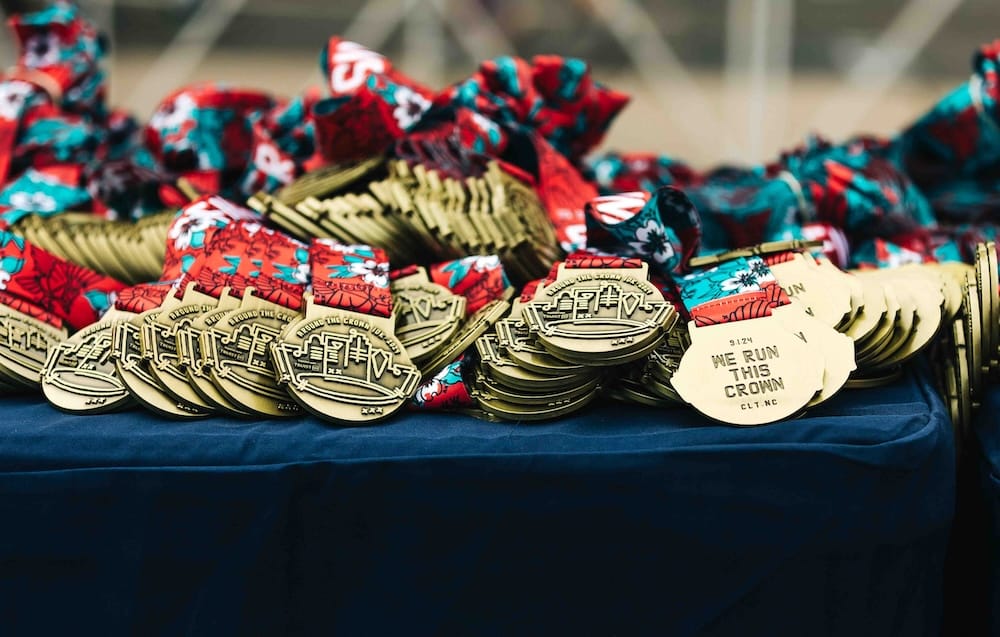
The way that we give back is we have an opt-out with our medals. So if you’re someone that’s run 25, 50, 100 races, and you don’t need another medal, we allow you to opt out. The price stays the same, but we take that money we would have spent on your medal and we give it to the Adé Hogue Foundation and/or the scholarship.
Each year, we have about a 15-20% opt out. So when that goes to 7,000 people, it’s a fair amount of money we’re able to donate through a pretty easy solution, and it also kind of hits on our sustainability initiatives as well.
For people visiting Charlotte to run the Around the Crown 10K, what are a few things you recommend they do while in town?
Brian Mister: We have a huge afterparty at NoDa Brewing …. We have food trucks there. It is just a community gathering afterwards. It feels like a family reunion, and it’s just so easy and fun. There’s live music. I highly suggest that.
Something else that’s pretty unique to Charlotte…is the Whitewater Center. It’s a gem for Charlotte. We’re so fortunate to have that place. It’s multiple restaurants, like 250 beer taps at six different locations. It’s 60 miles of trails. It’s live music. They have a celebration going on that weekend. I really enjoy that place.
There’s a parkway to get in there, so it’s like a mile and a half, through the woods, and you just kind of feel like you’re getting out of town. [There’s] ziplining and kayaking and this deep-water solo-climbing wall that you climb on upside down without a harness and fall off into a 20-foot pool — the coolest stuff you could ever think of.
Beyond that, we have great food and beverage options…coffee, deli, breweries, barbecue …. You could just go through every single neighborhood and list off 10 locations to go eat at.
[An] all-time favorite, downtown…[is] this little hole-in-the-wall called Al Mike’s. It’s Alexander Michael’s tavern. It’s in this house from the 1920s and no reservations allowed. There are maybe 25 tables and 10 seats at the bar. It’s just this beautiful old house, and you kind of have to know it’s there. They’ve got beef stroganoff and a black bean burger that’s so good.
Follow @aroundthecrown10k on Instagram.
“Something that we’ve said is we really want to work towards our start line looking like our community. And it’s not something that you can just flip a switch and change overnight.” – Brian Mister