Nashville’s Sin Miedo Founders on Welcoming BIPOC Runners to the Trails and Why Data Representation Matters
Access, education, and safety are top priorities for Yo and Antoine, co-founders of Sin Miedo, a BIPOC trail running community in Nashville. They share why including representation in race data is critical in creating a more inclusive trail running space.

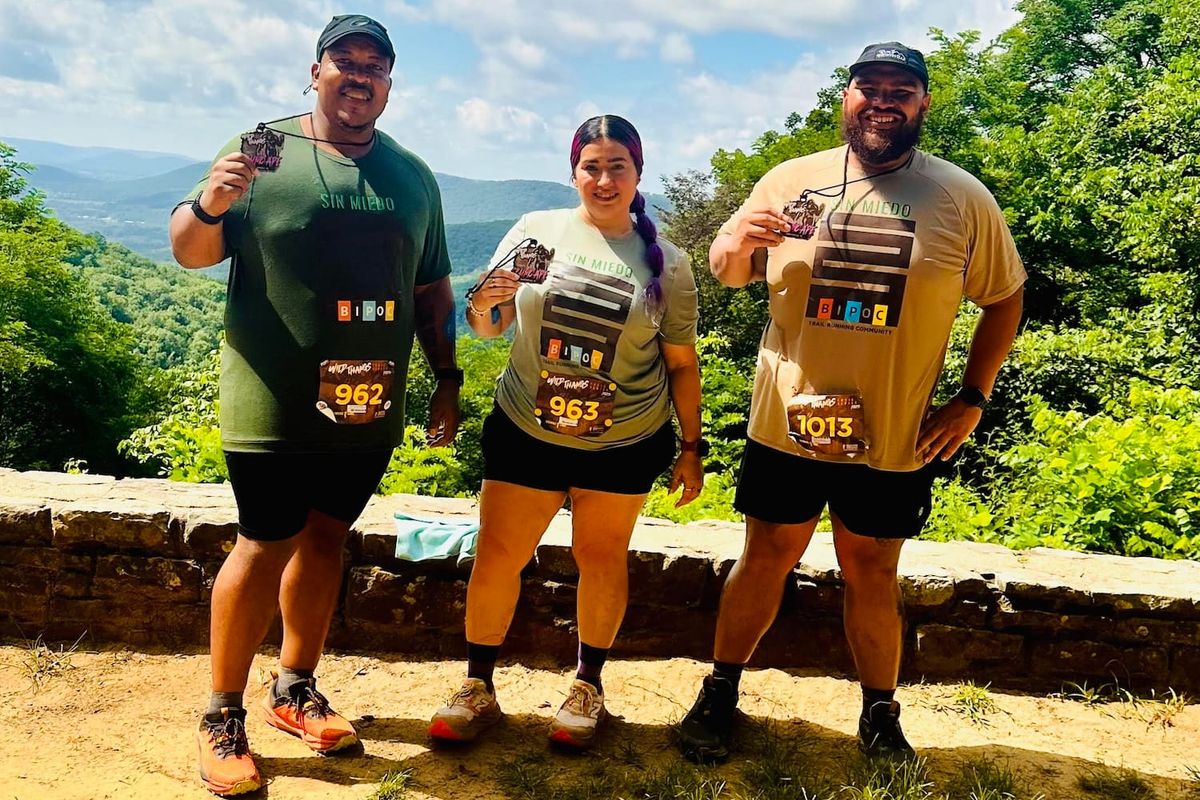
At the start of 2025, Antoine Haugabook had been hitting the pavement daily for more than six years. He began a run streak in September 2018 and was still going.
“Running became my outlet and my identity for quite a while,” Antoine shares. “In fact, during Covid, I ran relentlessly. I ran a half marathon distance every weekend in the year 2020.”
A pacer for Fleet Feet and co-captain for Nashville’s Black Men Run chapter, Antoine’s running was almost exclusively on the road.
When the Running Industry Diversity Coalition (RIDC) opened applications for an initiative called Freedom to Run: Back Outside, designed to help more runners of diverse backgrounds explore the trails, Antoine applied.
“I was getting burnt out on running in the road at that point, so I figured I would try a new avenue,” he shares.
Antoine and fellow Nashville-based runner Gabe Marrero were accepted into the program that spring. The two of them, along with Antoine’s wife, Yolanda “Yo” Lopez Haugabook, ventured out to the trails together.
Newer to running, Yo trained for and completed her first marathon at the Every Woman’s Marathon in Savannah, Georgia, the previous fall. Through her experiences with training, pacing, becoming a Fleet Feet Nashville ambassador, and being part of the running community, she fell in love with running culture.
But on the trails, she shares, things felt different.
“Nobody said, ‘You’re not welcome here.’ Nobody made a comment. But the energy, when we arrived, was different than what we were used to, especially coming from such a tight-knit community in the running spaces where we had been going to,” Yo shares. “We quickly realized that it was because there were no other people of color.”
After a few consecutive weeks of trail running, another trail runner who they’d seen before said in passing, “Y’all haven’t had enough yet?”
Yo says the comment sparked a fire in her to continue.
The following weekend, a few friends joined them at the trailhead, where Yo and Antoine proposed an idea: a trail running group for people of color.
“Within that week, we had a logo, we had a private group, we had community guidelines. We started our Instagram,” Yo explains. “Sin Miedo was born. It just took off.”
Learning the Trails Together
Sin Miedo Trail Runners launched as a BIPOC-led trail running community in Nashville in May 2025. The name Sin Miedo, Spanish for “without fear,” was chosen intentionally by Yo and Antoine.
One of the first posts to the group’s Instagram account reads:
“For many of us, the outdoors wasn’t a place we were taught to explore. And too often, it hasn’t been a place we’ve felt welcome. But Sin Miedo is how we reclaim that narrative; we do belong. We take up space, without fear of judgment. Without fear of being visible, joyful, and free.”
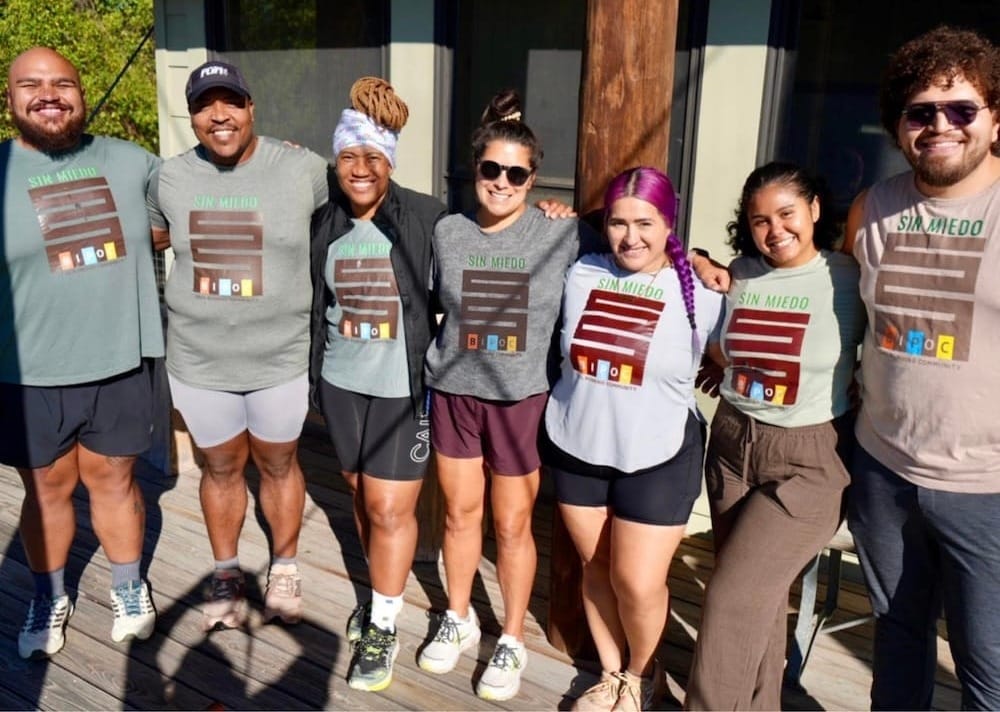
The group quickly grew from seven runners to 130 active members, many of whom not only attend the weekly trail runs but also participate in races together and other group events that prioritize trail running education. Sin Miedo has facilitated sessions for members to learn about trail running gear, race nutrition, ultrarunning, and various recovery modalities, among other topics.
“We do have such a mix of athletes. We don’t want to always talk to the beginner athletes,” Yo explains. “We try to talk to everyone, so that everybody feels part of the community.”
As BIPOC runners from diverse backgrounds, they’ve also found opportunities to share their cultures with one another. For Día de los Muertos, or “day of the dead,” they explained the Hispanic tradition of honoring their ancestors. They set up a community altar at the trailhead where members could leave photos and trinkets that reminded them of their own loved ones who have passed on.
“We cried together. We hugged together. We had authentic Mexican chocolate and pastries, and just talked about the importance of remembering that we are someone’s ancestors and that we have to make way for our future generations to know that we were here too,” Yo recalls.
Without Fear, But Always Safety-Minded
While working to create a space without fear for BIPOC trail runners, safety, especially for the group’s Latino and immigrant members, became an immediate and even greater priority.
Coinciding with Sin Miedo’s early months was the start of the nation’s targeting of immigrant communities, with the expansion of the United States Immigration and Customs Enforcement (ICE) and its unlawful use of racial profiling to arrest, detain, and deport individuals.
“We are having these conversations,” Yo says. “How are we going to navigate what’s currently happening in our country, and what is the responsible thing for us to do and say, and not to do, while still creating a sense of normalcy and a safe haven for our athletes?”
“Community is resistance” is the position they’ve connected to as a group.
“For us, to hopefully do our part, [we want] to not erase the fear, because that’s not realistic, but to minimize the barriers and blockages that create this fear so that they can experience the outdoors,” Yo explains. “We are very careful with that, as far as how we move and where we go, and even when we get invited to things. We don’t just say ‘yes’ to everything.”
Each week, Sin Miedo changes its meetup location and shares it on a private group platform. Before signing up for a race, they take steps to determine whether their runners will experience a welcoming environment. This often includes perusing race photos to gain insights into the diversity profile of the participants.
“Our people just want to run. They just want to run free. That’s our slogan: ‘Run free. Run bold. Run Sin Miedo,” Yo shares.
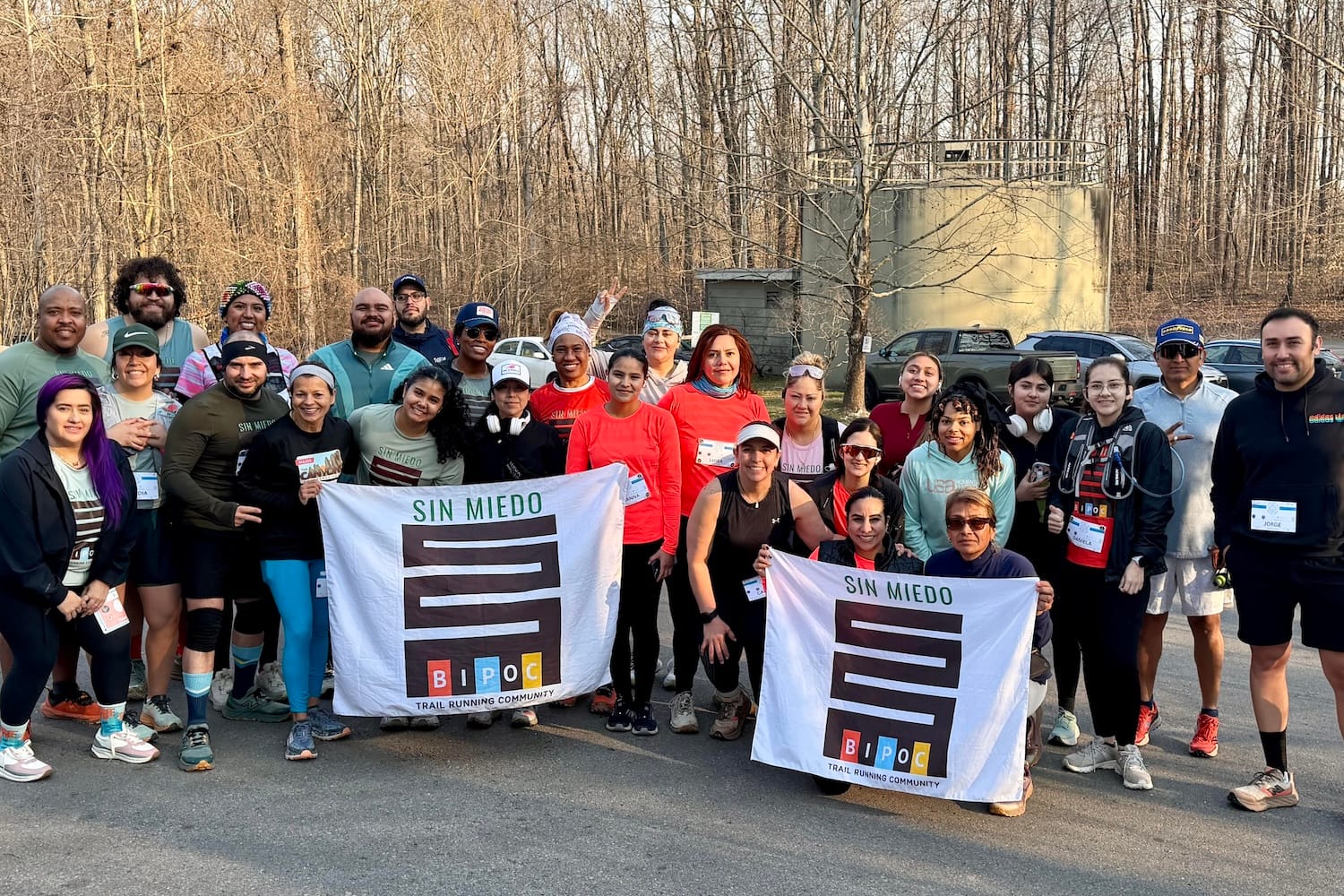
Representation Matters
Representation in running, especially trail running, is not particularly well-documented. But it’s an effort, if race directors choose to make it, that Yo and Antoine believe would serve as an important step toward creating more diversity-inclusive environments.
In addition to the work they’re doing in the local community to provide access, education, and safety for fellow BIPOC trail runners, Yo and Antoine are having progress-driven conversations at the industry level.
Below, Yo and Antoine — who closed out his seven-year run streak last September — share more on trail accessibility and education and the ways Sin Miedo is meeting their community members where they’re at. Plus, they offer insights on how the trail running industry can create a more inclusive space by communicating representation through data.
What barriers to trail running do BIPOC runners experience?
Antoine Haugabook: A lot of it is attributed to exposure, education, and just feeling welcome in an unknown environment. Obviously, there’s additional barriers with resources, but that leads back to education — just not knowing what you need or what’s appropriate. I mean, something as simple as a pair of socks…that there’s a difference between regular socks and running socks or trail socks, and how much of a difference that makes.
The knowledge gap is a big part of the lack of access, or the lack of knowing what to do in order to become a part of a group like this. That’s why the education piece is such a big component. And exposing everybody to the community and the trails has been a game-changer for a lot of people that may never have tried this on their own, or may have not ever experienced being active in the outdoors.
Yo Lopez Haugabook: And of course, we have to include the systemic barriers as well, and how many BIPOC communities live in urban areas. They don’t have access to green spaces or trails or even safe outdoors. We can easily say, ‘Well, just go for a walk. It’s fine.’ Like, no, it’s not.
It’s really important for us to also see that some of those barriers are lack of investment into our communities and outdoor programs. That inevitably creates this generational disconnection from the outdoors and from nature …. I think it’s important that those of us who have access, we share with our communities. That we do our best to erase that idea that this isn’t for us, because representation matters, because it creates access.
In what ways is Sin Miedo working toward closing the gaps in access and education?
Yo Lopez Haugabook: Our weekly runs are our way to introduce people to the trails and to each other …. We meet every Sunday and provide several options to cater to our community that includes beginners, experienced, and ultra-distance runners.
If we’re preparing for a race, then we’ll try to figure out what that race location is, especially if it’s local, or what similarity we can find in our trails to expose people to the terrain …. This includes different elevations, experiences, and the opportunity for our athletes to see trails that, otherwise, they would have never entered on their own.
During the week, we may share things in our private group, on our Instagram — what gear to look for, what kind of fueling they need to do.
At our first race, we shared GU products that were provided to us through the GU Gives program …. We gave it to everybody. We explained it. And some people didn’t use it because they didn’t know any better. Now, if you put GU out on the table, you better believe it’s getting used.
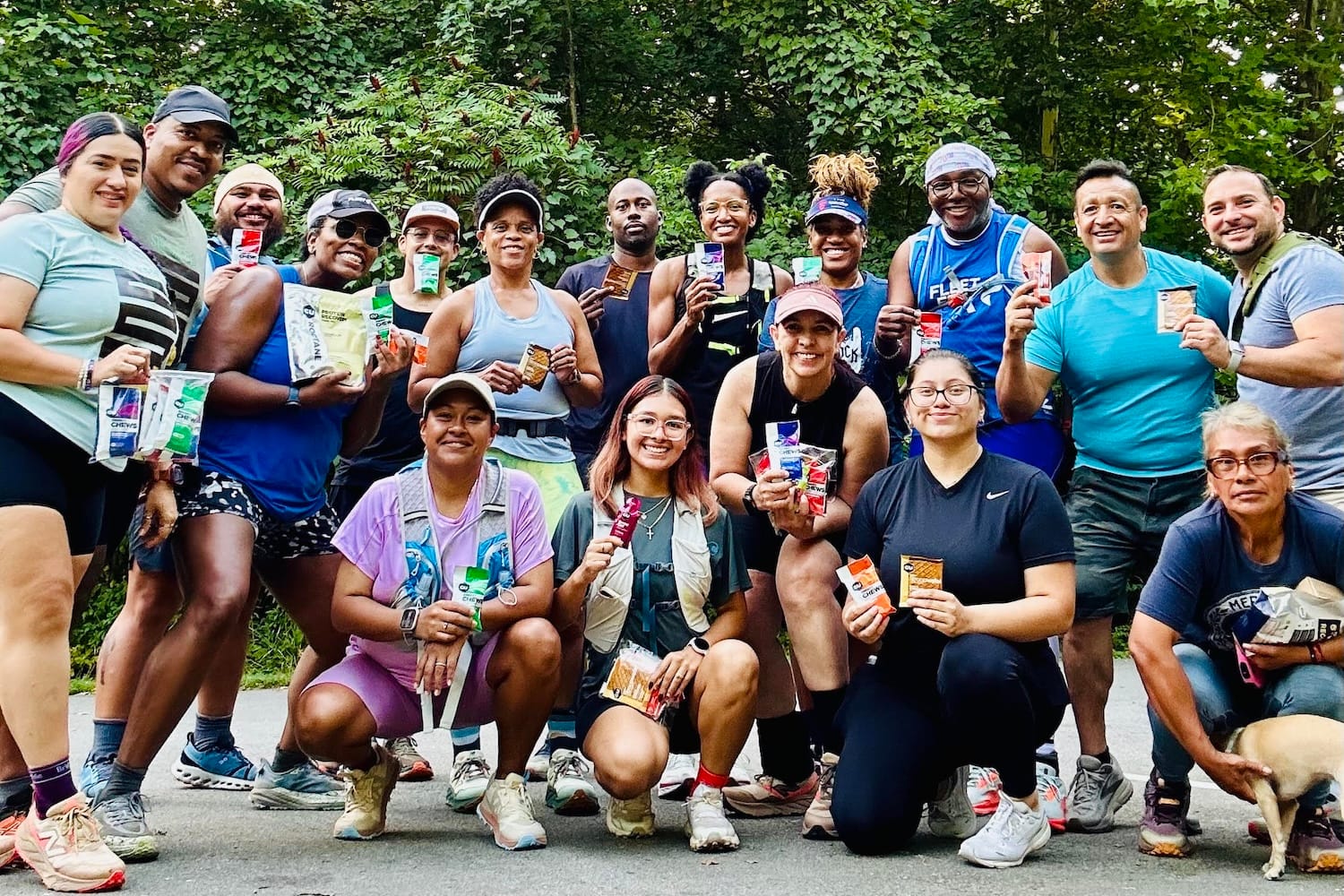
We also have things like shop nights, where we will go to a local run specialty store. We have had a panel of BIPOC people who are professionals in the outdoor industry, and some in trail running. They came out and spoke to us about their experiences. For example, we had Dr. Jocelyn Imani, the National Director of Black History and Culture with Trust for Public Land, come out. So, we learned about the stewardship of the land and how to be better neighbors to each other.
We also do things for recovery …. Gabe is a yoga instructor, so he might lead us through a yoga flow post-run. I do sound bowls and breath work and talk about nutrition education. Or one of our members, Alexandra Mayes, who is a licensed professional counselor, will chat with us about the importance of mental health. Whatever we can to expose our members to different modalities of recovery.
We’re all learning together, but it’s been so rewarding to be able to share that with them and see them growing, blossoming, and moving forward. People that started with just a 10K race now doing 20 miles or preparing for their first 50 is just mind-blowing and really awesome to see.
Why is increasing representation in trail running important for welcoming more BIPOC runners into the space, and what do you believe is overlooked in the industry’s diversity efforts?
Yo Lopez Haugabook: When we sign up for a race, one of the first things we do is look at the photos. Before distances, before elevation. We’re asking, “Do we see people of color there?”
There have been times where we only saw one or two photos with people of color and thought, ‘Okay, maybe we can go there.’ And that’s a hard reality, especially in the South. We should be able to just show up and run without questioning how we’ll be received. Our people just want to run.
A lot of race directors ask, ‘How can we change that?’ And the truth is, it goes beyond access. It’s not just about race entries or gear. It’s about making room for us, allowing us to be seen, and meeting us where we are.
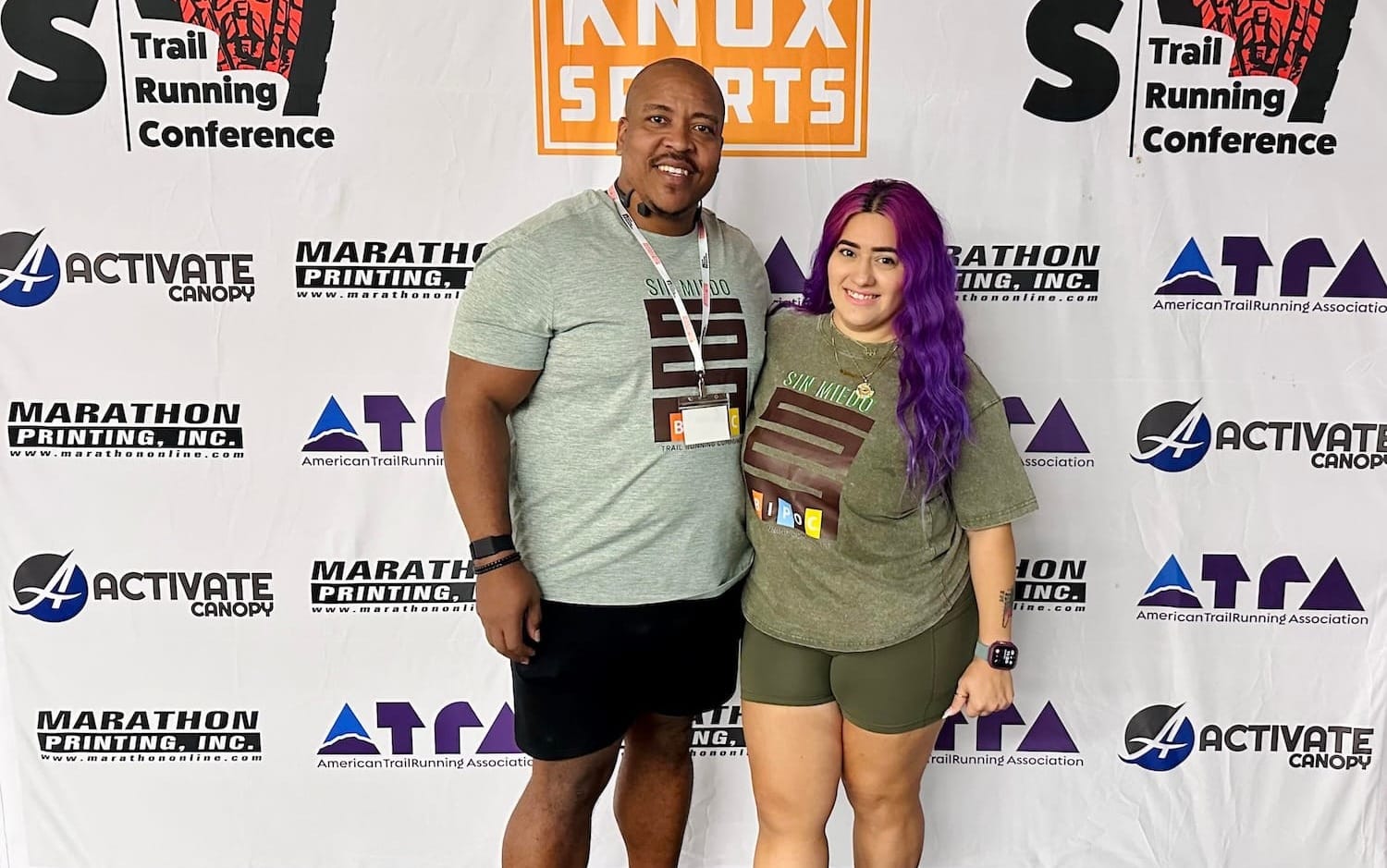
We had the opportunity to attend the US Trail Running Conference, where we connected with race directors and learned a lot. One session focused on data collection, and as co-founders of Sin Miedo, that matters to us. We want to know the numbers. We want to understand how many people of color are participating, and more importantly, who is staying.
But that information wasn’t readily available. It felt like it wasn’t seen as urgent or important. So it raises bigger questions. When do we collect data? When do we not? And who decides what matters?
For communities like ours, data is essential. It helps us understand growth, identify gaps, and see where people are being left out. Right now, there’s no clear record of how many people of color are participating in or completing trail and ultra races. That absence reflects a deeper issue of both exclusion and lack of acknowledgment. When these things are ignored, that silence speaks loudly.
Representation matters. Being counted matters. And having these conversations, even when they’re uncomfortable, is part of creating real change.
Follow Sin Miedo Trail Runners on Instagram.
“I think it’s important that those of us who have access, we share with our communities. That we do our best to erase that idea that this isn’t for us, because representation matters, because it creates access.” – Yo Lopez Haugabook