Triathlete Hilary Topper on Getting Into Endurance Sports Later In Life and Writing a Book for Beginners of Any Age
Hilary Topper started a blog to share her running journey. Years later, she’s still blogging and is also a certified triathlon, run, and swim coach. Last fall, she released her second book for endurance athletes, "Unlocking the Triathlon," to help others get started in the sport she loves.

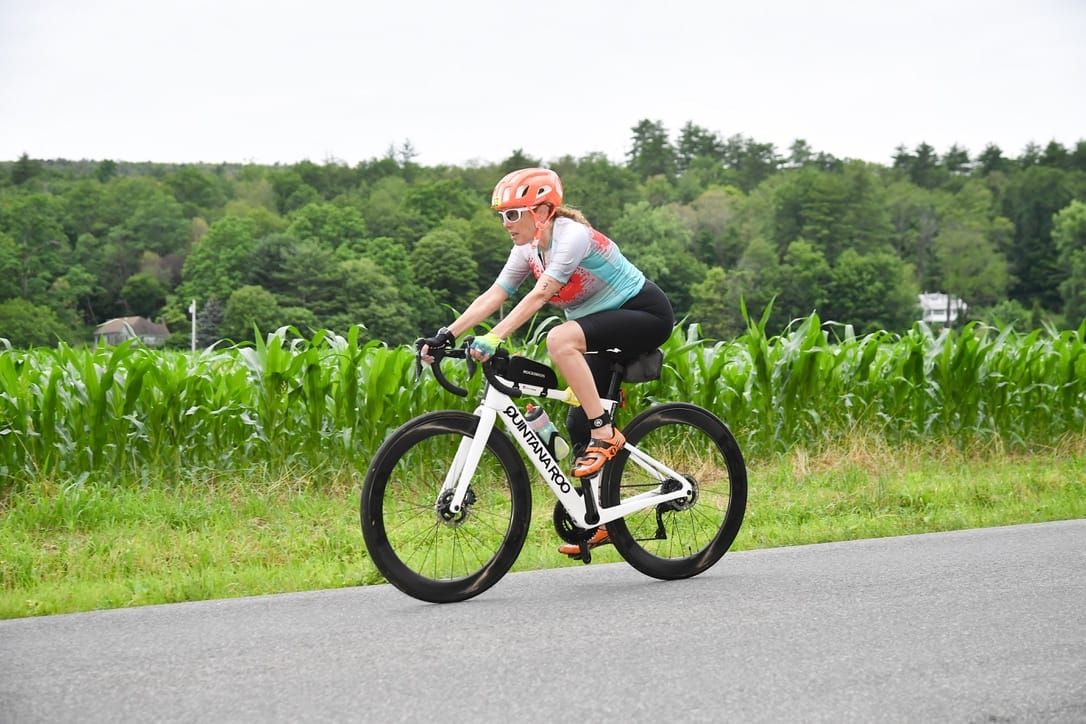
In her late 40s, leading a thriving public relations firm and parenting two kids, Hilary Topper needed some time for herself. She joined a gym and hired a personal trainer.
The pre-workout treadmill walks slowly evolved into running. Once she took her runs outside, met a training buddy, and participated in her first few races, she was hooked. On somewhat of a whim, after hearing about a triathlon held in an area of Florida she had visited, she signed up.
“I got into it because I was a runner. And I think a lot of people who are runners get into triathlon. It’s like another challenge,” Hilary shares. “I had to learn to swim, which I didn’t know. I had to learn how to clip into a bicycle, I had to buy a bicycle, and I had to piece the whole thing together.”
All the while, she had been documenting her journey as a runner in weekly online posts for a blogging collective website. In 2011, after her posts had grown a sizable audience, she branched off and created her own site called A Runner’s Diary. Years later, and with her newfound love for the triathlon, she evolved her site into what is now ATriathletesDiary.com.
Hilary’s first endurance sports book, From Couch Potato to Endurance Athlete, came out in 2022, and is largely based on her early blog posts about her running journey, with additional stories from her personal life that shed light on her motivation — her ‘why’ — to run.
Miles and Miles of Motivation
Growing up, Hilary Topper wasn’t encouraged to be athletic.
“My mother was always really nervous,” Hilary shares. “She didn’t want me to do anything physical because she was scared that I was going to get hurt.”
Hilary watched her mother suffer from various health ailments that worsened with age, including COPD, asthma, and post-polio.
“By the time she was 70, she was in a wheelchair. She had oxygen,” Hilary explains. “That was a big motivation for me. I am not getting like that. There was no way.”
Participating in running and triathlon events kept Hilary fit, but her training also gave her time to process heavy life events. The same year she lost her mother, who was 72 years old, her home in Long Island, New York, was destroyed by Hurricane Sandy.
Several years later, her sister passed away from a brain aneurysm.
“My sister called me. She had very, very bad headaches. She was experiencing these terrible headaches, and she was going to the doctor, and the doctor was telling her, ‘Oh, don’t worry, it’s just a migraine. It’s nothing,’” Hilary shares. “I spoke to her in the morning. She collapsed right after that phone call.”
On the bike, in the pool, and out on a run is when Hilary worked through her emotions. Writing about these life events for the book was difficult, she admits, but Hilary’s publisher knew it would resonate with readers.
“There was a section where I talked about my dad, and he had said to me, ‘I’m so proud.’ It was at one of the triathlons that I did in Florida,” Hilary says. “It was so emotional, because my dad never said that to me.”
Giving Back as a Coach and Author
On ATriathletesDiary.com, Hilary continues to share her training stories, writes about the races she participates in, and publishes gear reviews. Along the way, she decided to become an endurance coach, gaining certifications from USA Triathlon, U.S. Masters Swimming, and Road Runners Club of America (RRCA).
“I felt that I wanted to have the certification because of the blog. I thought that it would make me much more credible,” she shares.
After being coached by Jeff Galloway, Hilary earned certification as a Galloway Run Walk Run coach and started a chapter of the Galloway Training Program in Long Island. She later folded her own version of that training program into her virtual group for endurance athletes called WeREndurance, which also includes triathletes and masters-level swimmers.
Her experience as an endurance athlete, coaching expertise, and a desire to help others prompted her to write her newest book, Unlocking the Triathlon: The Beginner’s Guide to Completing a Triathlon.
Published last fall, the book is filled with training and gear information she wished she had when she was getting into the sport. Hilary also includes stories from fellow triathletes about their first race experiences.
Recent signs are pointing to the triathlon regaining popularity, even though its heyday was a little over a decade ago. USA Triathlon is investing in initiatives to attract young participants. But Hilary believes the age demographic most likely to get into endurance sports as a way to take on new challenges is 50- to 70-year-olds, with kids who are grown and in either stable careers or entering retirement.
Ultimately, her book is written for anyone interested in giving the triathlon a try.
Looking Toward the Open Water
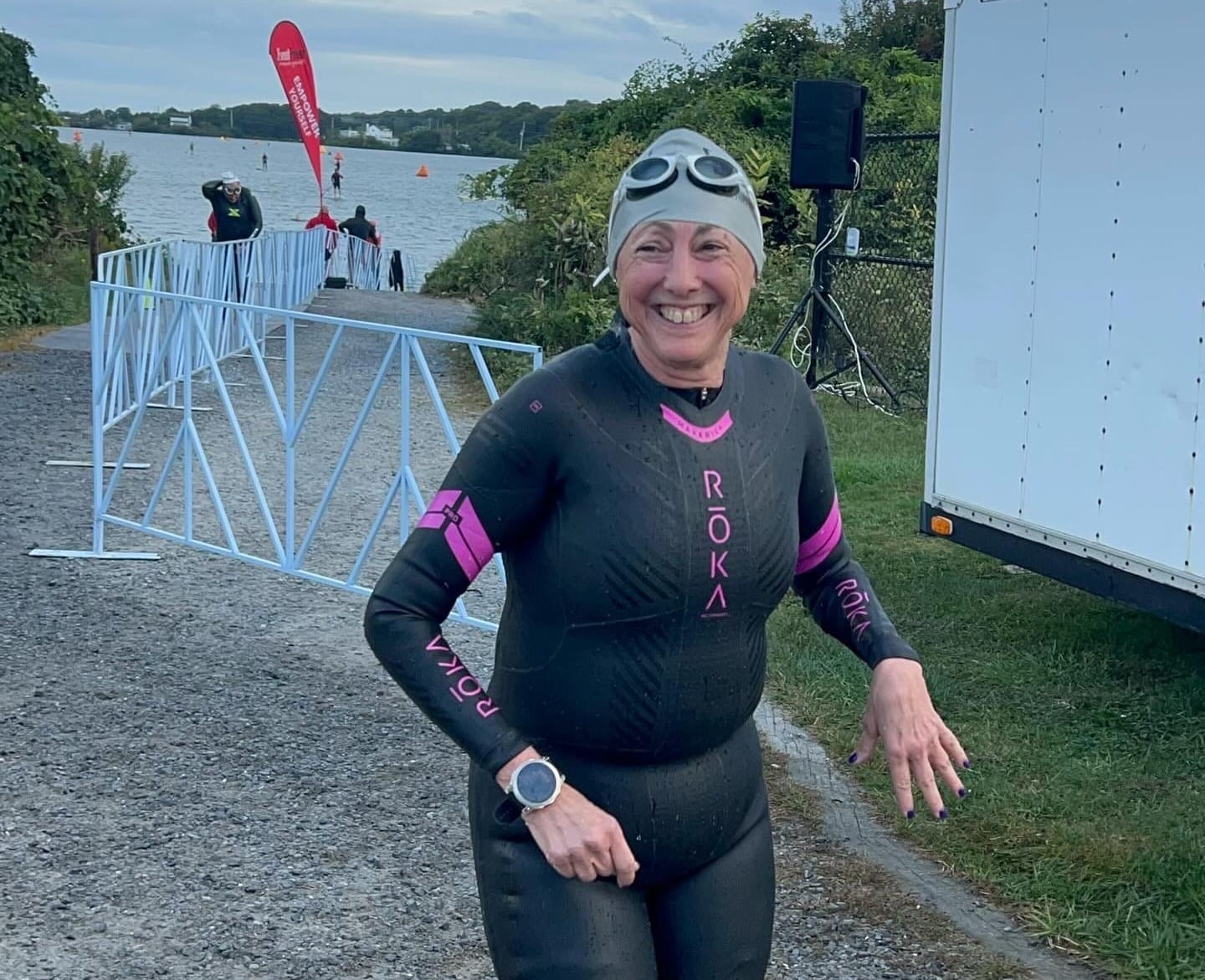
While Hilary still participates in sprint-distance triathlons, a knee issue has turned her attention to open-water swimming — the triathlon event she once dreaded most. In 2025, she completed the Mackinac Island Swim, an 8.2-mile loop around a small island in Michigan’s Lake Huron, and a 5.5-mile swim across Great South Bay, from Fire Island to Bayshore, New York.
Later this year, Hilary is set to release her next book, Unlocking the Open Water, intended to help others become more comfortable in open-water swimming. With this book, as with the other two, she hopes to instill in readers the confidence to sign up for that next race — or a first triathlon.
“Just go for it. Don’t hold back. If you don’t know how to swim, you can learn how to swim. I learned how to swim,” Hilary shares, reflecting on her own experience. “I did a triathlon three months later. I mean, if I could do it, anybody could do it.”
Below, Hilary shares how she began her running and triathlon journeys; what inspired her to write her latest book, Unlocking the Triathlon; and what she’s learned about herself through being an endurance athlete.
How did you first get into running?
Hilary Topper: I was 48 years old. I was working at my public relations firm …. I just felt like I was working constantly, and if I wasn’t working, I was taking care of the kids. My kids were little at the time. And then I was taking care of my parents. They were getting older. They needed more help. So, I never had time for myself. At 48, I was like, ‘You know what? I need to change my life.’
I joined a gym for the first time, and I had never been to a gym before that. I hired a trainer, and my trainer said to me, ‘Listen, go warm up on the treadmill, and then we’ll work out with weights.’ He leaves me. I’m there looking at the treadmill, like, ‘What am I supposed to do with this?’ I had no idea. I asked the woman running next to me if she could help me.
She stops what she’s doing. She was not the happiest, but she was graceful about it, and she showed me how to turn on the treadmill, and I started to walk. Eventually, as I started doing these personal training [sessions] and working out on the treadmill, I started to run a little bit. Then I started to run more. And I decided to take it outside and start running.
I met this woman in a women’s group. She had just done the New York City Marathon, and she said to me, ‘Do you think that we could run together?’ And I said to her, ‘You don’t want to run with me. I’m just starting out. I really don’t even know how to run.’
We ran on the Long Beach Boardwalk …. She couldn’t run straight, and I couldn’t run straight. We were kind of doing a run-walk. I didn’t even know what we were doing at that point, but we were just doing it.
I guess it was about a month into it, she said to me, ‘Let’s run the half marathon.’
When did you discover the triathlon?
Hilary Topper: I was an original Google Glass explorer. Google Glass…it had a little screen on the top, and you could take photos and video and stuff like that. There was a contest. I had entered it. I wanted to wear it for the Diva Half Marathon, and I didn’t get accepted. When I got back from the Diva Half Marathon, I wrote on Twitter at the time, ‘I want my Google Glass more than my MTV.’ And they were like, ‘You’re in!’
I was invited with four other people on an exploration with Google Glass to Sanibel Island in Florida …. We were basically asked to take pictures of the island…[to] get people interested in coming there for vacation. While I’m there, this woman says to me, ‘Listen, you’re a runner. You would love the Captiva Tri. It is amazing. You have to do this.’ And it sounded so nice because the area was so beautiful.
I didn’t really think much of it until my training partner and I did the Brooklyn Half Marathon …. She said to me, I guess it was mile eight, ‘You know, my back is killing me. I never want to do another long race again.’ I was very disappointed, because I loved it so much, so I said to her, ‘Well, maybe we should do a triathlon.’
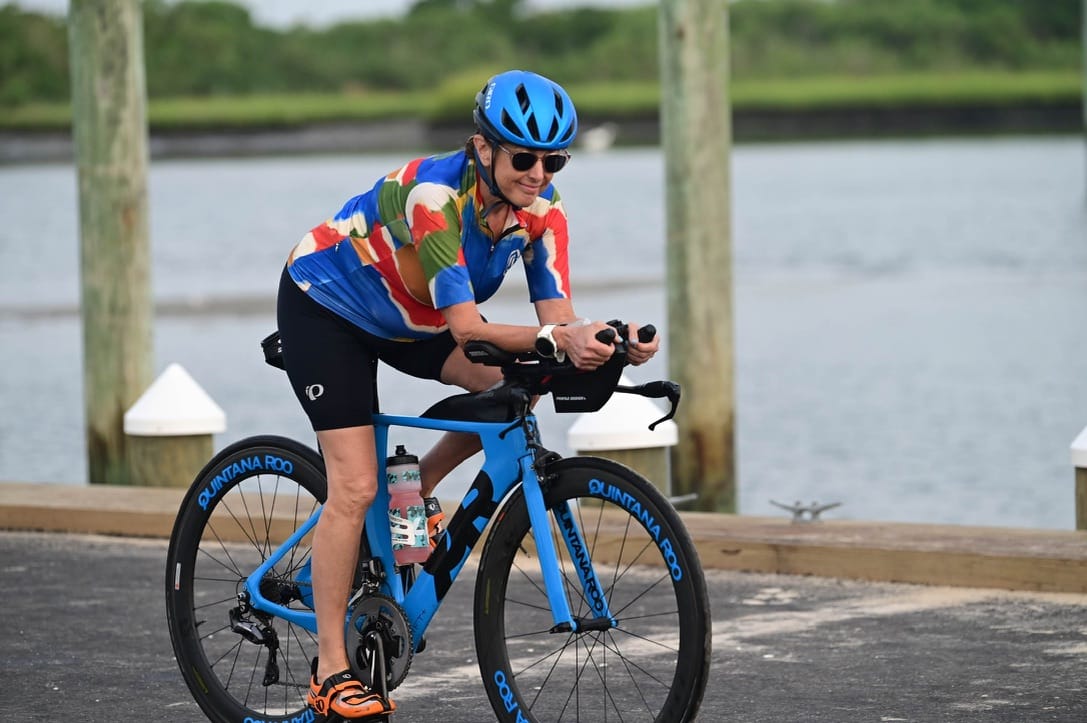
I really didn’t even realize what a triathlon was. I didn’t know it was a swim, bike, run. I didn’t know really anything about it, except that I knew that there was one in Captiva that I wanted to do because of this woman who inspired me.
What motivated you to write Unlocking the Triathlon?
Hilary Topper: When I started triathlon, I was so into it that I was going out, buying all these books. I read Joe Friel’s book and Matt Fitzgerald’s books and Matt Dixon’s books. There are a ton of books out there, and I was just reading them all. Most of them were totally over my head. It was a lot of physics in there that I just didn’t find necessary.
This book caters to the everyday athlete …. I wrote it as a very basic ‘how to get started’ book.
I wanted it to be a little different. I wanted to put people’s first-time stories in there. So, I’ve got Gwen Jorgensen’s story. I’ve got Matt Fitzgerald’s story. I mean, you start becoming friendly with these people through the years. I’ve got other age groupers and very diverse individuals …. They just pop up throughout the book. I thought it was good to break up the book that way, to have those stories. And then I also interviewed the Pathetic Triathletes on Facebook, and they shared stories with me, funny things that happened to them during a tri. So before each chapter, I have those funny stories.
It’s serious, but not so serious.
I include a whole section on DNF. Is it so horrible to DNF? Some people think it’s the end of the world. Or being at the back of the pack is the worst thing in the world …. At least you’re out there doing something outside your wheelhouse. Most people are not. Most people are sitting on the couch.
What have you learned about yourself through participating in endurance sports?
Hilary Topper: I have learned so much about myself through endurance sports, especially coming to terms with certain things that were difficult to come to terms with. Coming to terms with my mother’s death, with my dad having Alzheimer’s.
Our house got destroyed during Sandy in 2012. My mother had passed away right before Sandy. She still had all her stuff in my house, on the first floor, and the first floor got destroyed. So, they’re carrying out my mother’s chair that she would come and sit in in my house. And that was emotional, very emotional. Running really helped me to come to terms with a lot of this stuff. Things that happened along the way, I was able to really resolve through running.
If I’m alone out there on a long endurance ride or run or swim, things that have happened, I am able to decompress. I’m able to really think about them and come to terms with them. I feel like I’m a stronger person for it. I feel like I can now give back. Before, I felt like I just needed to work on myself. And now, I feel like it’s gotten to the point where I can give back.
Follow @HilaryTopper on Instagram.
“I just felt like I was working constantly, and if I wasn’t working, I was taking care of the kids. My kids were little at the time. And then I was taking care of my parents. They were getting older. They needed more help. So, I never had time for myself. At 48, I was like, ‘You know what? I need to change my life.’” – Hilary Topper